Employee of the Month
November 14, 2026
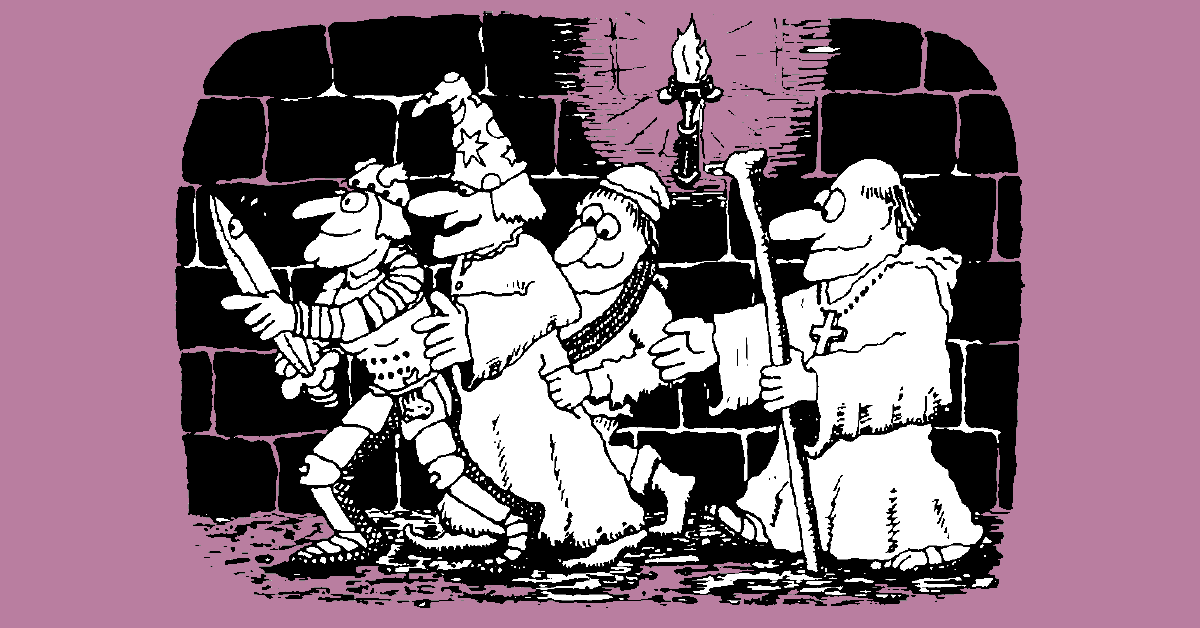
Illustration by Tom Wham, from Dungeons & Dragons(TSR, 1977).
Part of the joy of being a seasoned adventurer is the job creation you enable.
The trickle down economics of killing monsters for loot and then hiring employees to help you rid the monsters of even more loot is a venerable tradition. Here are some general NPCs that can help your adventurers during those deucedly daring delves into dungeons deep.
Now, any GM worth her salt probably has most of this down, but if you're looking for something "quick and dirty", this blog post is for you. And if you're looking for a generator for your various Dungeon Employees, I keep my vibe-coded AI gaming stuff over at themobos.com if you're in need .
On to the show, but first a note on ...
Loyalty
"Dungeon employees" are loyal to their employers up to a point. Each employee has a Loyalty score of between 2 (ready to leave at the first opportunity) and 12 (fanatically loyal to the point of being uncomfortable).
Good treatment can make an employee's Loyalty go up, and poor treatment will drop it. Raising or lowering an employee's Loyalty is at the Arbiter's discretion.
Of course, nothing says “I value you” like cold, hard coin. Paying an employee more than the going rate is a fine way to raise their Loyalty (even their starting loyalty). How much more is between the employer and the GM.
Employees won't take overtly risky actions (e.g. being first down a hallway, or pulling an unmarked lever), but may be persuaded to perform moderately risky tasks (like standing watch) with a Loyalty Test.
Loyalty Tests
Making a Loyalty Test is simplicity itself - roll 2d6, and if the result is greater than or equal to their current Loyalty, the employee thinks that this shit ain't worth it.
If an employee fails a Loyalty Test, their Loyalty moves down by 1. Loyalty Tests can be made at any time the GM deems it necessary, but some general rules:
Out of Combat
Employees will need to make a Loyalty Test if:
- they're asked to do something moderately risky (like standing watch)
- they're asked to take more risk than the rest of the party.
- they're threatened by their employer or any member of the party.
- their employer is being especially dickish.
Failure on a Loyalty Test while out of combat means the employee simply refuses to do what's asked.
In Combat
Employees will need to make a Loyalty Test when:
- the first adventurer is incapacitated (including "killed").
- half the adventurers are incapacitated (including "killed").
- their employer is incapacitated (including "killed").
If a Loyalty Test is failed during combat, the employee will run or surrender or grovel or whatever is necessary to not get killed.
If an employee ever hits 2 Loyalty, they'll try to escape as soon as possible. Maybe with their employer's stuff.
Hirelings
Hirelings are non-combatant workers or aides hired for 5 coins per day, plus food. In combat, they flee for cover. If attacked (e.g., in an ambush or targeted by a creature), they are killed instantly at the GM's discretion.
Starting Loyalty for Hirelings is 3
Torchbearer/Linkboy
Torchbearers or linkboys are cowardly, weak ... and inexpensive. They hold torches so you don't have to. They only have a 1 in 6 chance of a torch going out if they should drop one for any reason, and they are able to light a torch using one action. Torches not included.
If you're using the Totality of Ygg rules, Linkboys only move a torch's [RES] on a 1 (instead of a 1 or a 2), and they can carry up to 6 Burden of gear.
Porter/Bearer
Beefy numbskulls hired to carry your stuff. They have high strength (15 out of 18, for example) when it comes to calculating their encumbrance and opening doors. Porters are also often used to dig graves, mine ore, and bash down doors in addition to carrying stuff that you don't want to.
If using the ToY rules, they can carry up to 12 Burden worth of gear.
Cook
Good to have on long journeys, Cooks can ensure that everyone is fed and (hopefully) nourished. Their food can heal minor damage (say 1d3 HP or the equivalent), and they know how to make a meal really stretch.
If using the ToY rules, a Cook's Provisions [RES] only moves on a 1 (instead of a 1 or a 2).
Guide
Guides know how to get somewhere specific, and are thus very useful when traveling off the beaten trail. A party that has employed a Guide to a specific location will have little to no chance of getting lost.
If using the ToY rules, a Guide has a rank of Master (d20+3) in Bushcraft, but only in areas with which they are familiar.
Mercenaries
Mercenaries are more capable and professional than standard Hirelings, working for a half share or 10 coins per day (whichever is higher) plus food. They stay Close to their employer, participating in combat but avoiding overt risks without a Loyalty Test.
Starting Loyalty for Mercenaries is 6
Meatshield
Mercs. Footsoldiers. Infantry. Chattel. They go by many names, but they do the same job - take hits and stab bad guys.
There are a handful of different ways you can handle Meatshields as the GM - rolling up a level 0 or level 1 fighter is probably the most flexible, but it can be difficult for both players and GMs to ... well frankly, to remember they're there.
You may find it easier to just have Meatshields give their employer some bonuses. In the ToY rules, each Meatshield can (a) grant their employer +1 to their Attack or Guard tries; (b) grant their employer +1 on damage; or (c) take any physical damage for their employer. The employer has to specify what each Meatshield is doing at the top of the Moment, i.e. "Slab is giving me +1 damage and I'm keeping Fridge the Lesser back to take damage in case things go south". You can give a Meatshield armor, but they're pretty weak - 4 Flesh and 4 Grit (or d6 HP, or what-have-you).
You can employ up to two Meatshields - more than that and it starts to look like an army.
Vicar
Vicars are best thought of as "clerics in training". They can heal a hit point of damage (or two, if you're feeling generous), maybe turn a (one) skeleton, or bless you so your next attack gets a +1 to hit.
Vicars aren't fighting types, and can't make any attacks. They have a few hit points and are able to wear armor, but assume any attacks on them hit automatically.
If you are using the ToY rules, a Vicar has 4 Flesh and a Grace die with which to perform the Vulgate of Sacraments.
Employing more than one Vicar of a different religion can result in ... complications.
Minstrel
Singers, storytellers, and hedge mages. They are generally skilled in lore, and will keep a record of your exploits to regale people with back in town.
When resting, a Minstrel can juice the party's ability to heal by a little bit (a few hit points). If a fight breaks out, Minstrels will run for cover. They tend to be very lucky, however - if they're attacked abruptly (wandering into an ambush or what have you) , roll a d4 - they're killed if you roll a 1, but are otherwise knocked out, fall into a ditch and hide, etc.
If you're using the ToY rules, a Minstrel is Skilled (d12+2) in Lore, and can heal 2d6 of the Band's Grit during a Breather, divvied up any way they wish.
Minstrels refuse to share the spotlight with other minstrels.
Trap Checker/Mechanic
A job for the brave or foolhardy, trap checkers make a living finding and disarming traps and secret doors. Each is armed with a three-meter pole in addition to other equipment. They are often found at the front of the party, but will quickly run to the back at the first sign of a fight. In addition to daily pay they are paid per secret door and trap they find. They are able to:
- Find secret doors as if they were an Elf
- Find and disarm traps at +3
If you're using the ToY rules, a trap checker or mechanic is Skilled (d12+2) in Tinkering, and gives you a +1 to your Attack and Guard tries (but doesn't take a turn in combat). Any physical damage you take can be applied to the Mechanic instead, who has 4 Flesh and 0 Grit.
Mechanics can't wear any armor, and refuse to work with other mechanics in the group.
Sawbones
Looks like the cleric just went down and there's still a lot of bad guys left - now what? Enter the Sawbones. The Sawbones carries a healing kit with 3 ministrations in it (and can be refilled back in civilization for a reasonable fee). This kit allows them to:
- spend a round to heal someone for 1 hp (including that cleric lying on the ground). Expends 1 ministration, 5 in 6 chance of it working.
- spend a turn (10 rounds) to try to set a broken limb. Expends 2 ministrations, 3 in 6 chance of it working.
- spend an hour to alleviate the symptoms of poison or paralysis. Expends 3 ministrations, 1 in 6 chance of it working
If using the ToY rules, the Sawbones can use the Vulgate of Medicine and has an [INGY] die of d4.