Rats in a Maze
November 1, 2026
Back in the day, mazes were a fantastically boring game between the GM and the party mapper - a role usually occupied by the most detailed and serious person in the group. A KoDT comic jumps to mind:
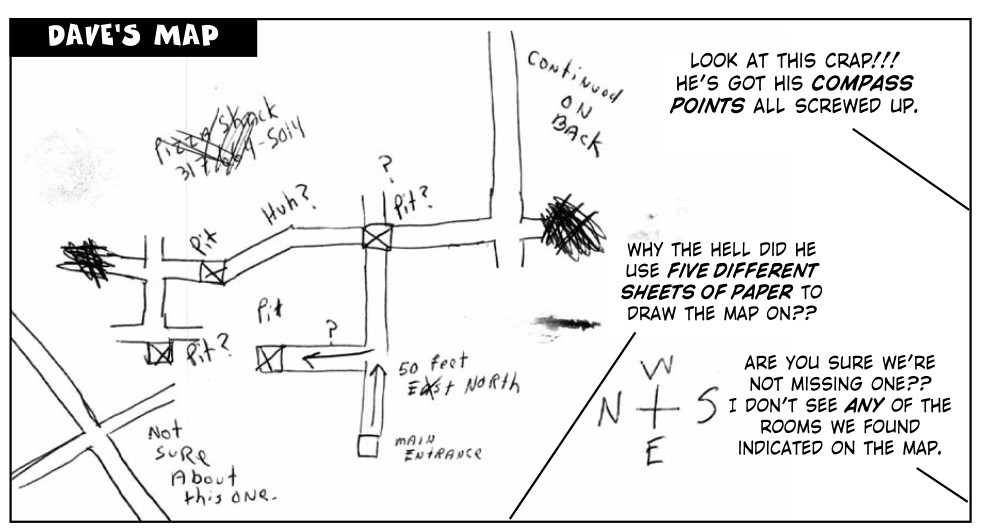
From "Wherever You Go, There You Are", Knights of the Dinner Table issue #6, April 1997
The Angry GM covered unsucking mazes in depth, and I won't re-litigate this masterpiece. He's not wrong :
And THAT brings us to why mazes in RPGs suck. First of all, there’s no real tension to it. By itself, a maze is just a matter of patience. It’s a foregone conclusion that the PCs WILL solve it. It’s only a matter of time. BY ITSELF, that’s no different from any other obstacle that the PCs can’t possibly fail to overcome. And it just isn’t very interesting. Second of all, a maze is full of false choices. Like, chock full. “You come to an intersection, left or right?” “You come to another intersection, left, right, or straight?” “You come to another intersection. Left or straight?” And that is how the maze plays out. FOR F$&%ING HOURS. And the thing is, those choices aren’t really choices. There’s nothing the players can do to discern which choices are good and which are bad. There’s nothing meaningful in the choices. It’s just a random choice. And, generally, the players will follow a heuristic, so there isn’t really a choice at all. They just ALWAYS turn right.
These are excellent points! But I love mazes and labyrinths (like the Hypercube Dungeon), and part of the reward of being a forever GM is what you can inflict on your players.
I kid, of course. But mazes and labyrinths feature in all kinds of fantastic literature and legend across the ancient world and beyond. In addition to the classic Labyrinth of Daedalus' Minotaur, we have: Roger Zelazny's "Pattern" in The Chronicles of Amber; Ursula LeGuin's Tombs of Atuan; probably a quarter of what Jorge Luis Borges wrote (The Aleph jumps immediately to mind); and last (but certainly not least) we have David Bowie's straining-spandex bulge in (appropriately) The Labyrinth, which is an argument unto itself.
I mean, look at this picture from page 102 of the 1e PHB:
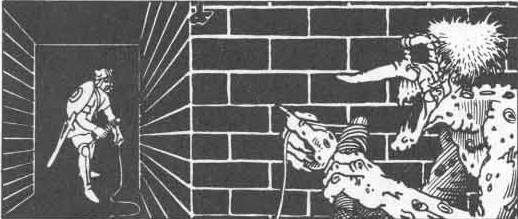
David A. Trampier from 1e D&D PHB (1978), on page 102. Please don't sue me, I have no money
Does that not fire something up inside your brain?
What's In a Maze?
So, what is a maze, exactly? I think I've got it narrowed down to the following "rules":
- Mazes are bounded places with walls and edges, and
- Mazes are places where players get lost, and
- Mazes have a way out
This expands a maze to not just be a physical walls turning every which way, but also to other places where players can't orient or see ahead. Fogbanks. Caves. And, of course ...
The Cornfield
Quick side note - one of my favorite moments in the video game Left 4 Dead was cresting a rise and seeing the barn we had to run to in the distance. But between us and the house lay a cornfield beneath a stormy, black sky.
Here's a quick "mini-game" from my upcoming module to run a corn maze (or any other maze of its type). You'll need a deck of cards, and to throw together some random tables before you game.
Take the twelve face cards (Jacks, Queens, and Kings) from a standard deck of playing cards. Shuffle them and arrange them face-down in a 4x3 grid in front of the players. This represents the cornfield.
To cross the cornfield and reach the other side, the players must collect four cards of the same rank: four Jacks, four Queens, or four Kings.
Each turn, the Band flips one face-down card. Depending on your system, allow the players to flip an additional card (or two) if they pass a particular skill test. For example, in the Totality of Ygg, the players may attempt either a Skill:Travel or Skill: Bushcraft roll and, if successful, may flip an additional card. Additionally, if there is a Pooka in the party (a character species with supernatural luck), then can flip another card. Any way you cut it, don't let the players flip more than 4 cards.
The party then collects one of the cards. Optionally, they can also create a Landmark (see below) on one additional card. Cards bearing Landmarks remain face-up. Cards that aren't collected or made into Landmarks are flipped face-down again, but remain in the same position. The players are free to remember what they have seen.
Once the Band collects four cards of the same rank, they arrive at their destination.
Gather all face-down and collected cards and reshuffle them. Leave any Landmarks where they are, face-up. Arrange the remaining cards into the grid again and repeat the process when the Band travels to another location.
Landmarks
The party may create a Landmark - tying a red ribbon to a cornstalk, clear-cutting a patch of ground, carving a marker, etc. - on any face-up card they have revealed but haven't collected. Leave that card face-up.
Only one Landmark may be created per turn. A Landmark can't be collected except via a Boon (see below).
Getting Lost
It's possible for the party to create Landmarks in such a way that no four-of-a-kind remains among the cards they can collect. This is by design. The party may still escape its predicament through a Boon or through Mishaps that affect Landmarks. If they cannot do so and eventually collect every remaining face-down card without completing a four-of-a-kind, they have become hopelessly lost.
The party will eventually emerge back where they began. Collect all 12 cards, including any Landmarks, shuffle the deck, and lay out a new cornfield. The Band may try again, hopefully a little wiser...
So far, so good? Just seems like a simple game of Memory, but add some randomization into the mix.
Each collected card triggers an encounter based on its suit. The GM should announce which table is being rolled on ("I'm rolling on the Monsters table," or, if you're feeling generous, "A club - so I'll roll on the Monsters table") so attentive players can use that information when deciding which card to collect.
| Card Is ... | |
|---|---|
| ♥ | Roll a d6 on the Boons table |
| ♣ | Roll a d6 on the Monsters table |
| ♠ | Roll a d6 on the Mishaps Table |
| ♦ | Roll x on the Weird Table |
Monsters Make a table of 6 monsters appropriate to your player's level - wandering monsters, essentially.
Weird Make a table of ... well, as many weird things as you can think of that the party might run into. I've got 36 total in my module. For example:
- The party emerges in a clearing containing their own footprints.
- All sound abruptly stops, until a murder of crows bursts noisily into the air
- A scarecrow is discovered wearing one of the party's pieces of equipment. When the party member checks, the item is, in fact, missing from their person.
- A low, moaning wind calls out one of the party member's names.
- etc.
Boons These are (hopefully) good things that might happen as the party wanders about:
- The next time the party flips cards, they may flip one of the revealed cards face-down and reveal a different face-down card instead.
- The next time the party flips cards, they may choose not to collect any of them. Flip all revealed cards face-down and try again.
- The party may flip one additional card next turn (max 4 cards).
- The party may flip 4 cards next turn.
- The party may immediately flip one Landmark face-down.
- The party may immediately collect one Landmark, if any exist.
Mishaps And for every good thing you have ...
- Flip one face-up Landmark face-down (GM's choice).
- Take all Landmarks on the table, shuffle them, and return them face-down to their previous positions.
- Swap one collected card with one face-down card on the table (player choice).
- Swap all collected cards with an equal number of face-down cards on the table (player choice).
- Take four face-down cards from the table, shuffle them, and return them face-down to their previous positions.
- Take all face-down cards from the table, shuffle them, and return them face-down to their previous positions.